When is the best time to plant a rose? #
November is typically the best time to plant roses and it is also the start of the bare root season. This is due to several factors, including the optimum soil conditions, handling of the rose, and a chance for the rose to establish a good root system before spring time growth begins. Bare root roses should be planted around this time to avoid frozen conditions and before new growth begins. Potted roses, however, can be planted at any time of the year as long as the ground isn’t frozen, waterlogged or in drought.
For more detailed year round information, take a look at our Rose Care Calendar.

Our potted roses arrive in containers that they are happy to stay in until they outgrow them, usually until the end of the season. This means that immediate planting is not necessary, and you can take your time deciding where it will go. It also means you can wait for the optimum time to plant (usually November – see here for why!), although they can be planted all year round. If you don’t want to plant them in a garden and instead keep them containerised, that’s fine too! Just increase the size of the pots as the rose outgrows them, and make sure to keep them well watered.
Bare root roses should be planted as soon as possible after arriving. It is recommended that you plant your bare root rose as soon as possible. However, if you cannot plant straight away (such as due to the frozen ground or severe weather conditions), it is important to keep your bare root rose in a cool, dark place. It is also vital that you keep your bare root rose moist and free from frost. An ideal storage location would be in a dark area of a garden shed or garage for up to 2 weeks. See here for our helpful bare root guides.
How do I choose the best place for my rose? #
Roses generally like a sunny position with a good amount of space around them. Six or more hours of sun is ideal, although if the area is prone to very hot or dry conditions some shade is no bad thing. Some roses will grow in partial shade, but most roses bloom their best if they are in a spot that gets sun all day.
Roses don’t have very specific requirements for soil type, so as long as the soil is in reasonable condition with plenty of organic matter, roses will grow. Also make sure the soil you plant your roses in has good drainage to avoid roots rotting in wet soil.
Finally, do not plant your roses too close together. The more airflow around the plants, the less likely they will be to get disfiguring fungal diseases such as black spot and powdery mildew on their leaves. Ensure to plant roses at least 3 feet from other plants to avoid competition for soil nutrients as well.
Equipment needed for planting a rose #
- New rose plant
- Garden spade
- Garden fork
- Work gloves
- Peat free rose compost
- Bark mulch
- Granular rose feed
How to plant your potted rose #
- Water your potted rose generously, immediately before planting.
- Prepare the soil thoroughly, using a fork to remove and weeds or large stones. This gives your rose more room to freely grow its root.
- Dig a hole big enough for the roots using a spade. This will likely be around 16″ wide x 16″ deep (40cm x 40cm). Save the soil you have removed.
- Break up the soil at the bottom of the hole using a fork
- Mix a spadeful of peat free rose compost and a sprinkle of granular rose feed and mix into the soil at the bottom of the hole. Mix 2 spadefuls of peat free rose compost with the soil that you have removed from the hole.
- Remove the rose carefully from its container. This is usually done by gripping the rose firmly (using gloves!) and inverting the container. Keep the soil that comes in the container.
- Gently loosen the roots slightly so they will spread out well when planted.
- Position the rose in the centre of the hole. The bottom of the stems should sit about 2″ (5cm) below the top of the hole.
- Fill the hole all around the roots, using the soil you removed (plus the soil removed from the container).
- Firm the soil lightly using your foot.
- Water the rose well, and apply mulch around the base.
- Continue to care for your rose at it becomes established, watering well and using granular rose feed (applied according to product instructions).

How to plant your bare root rose #
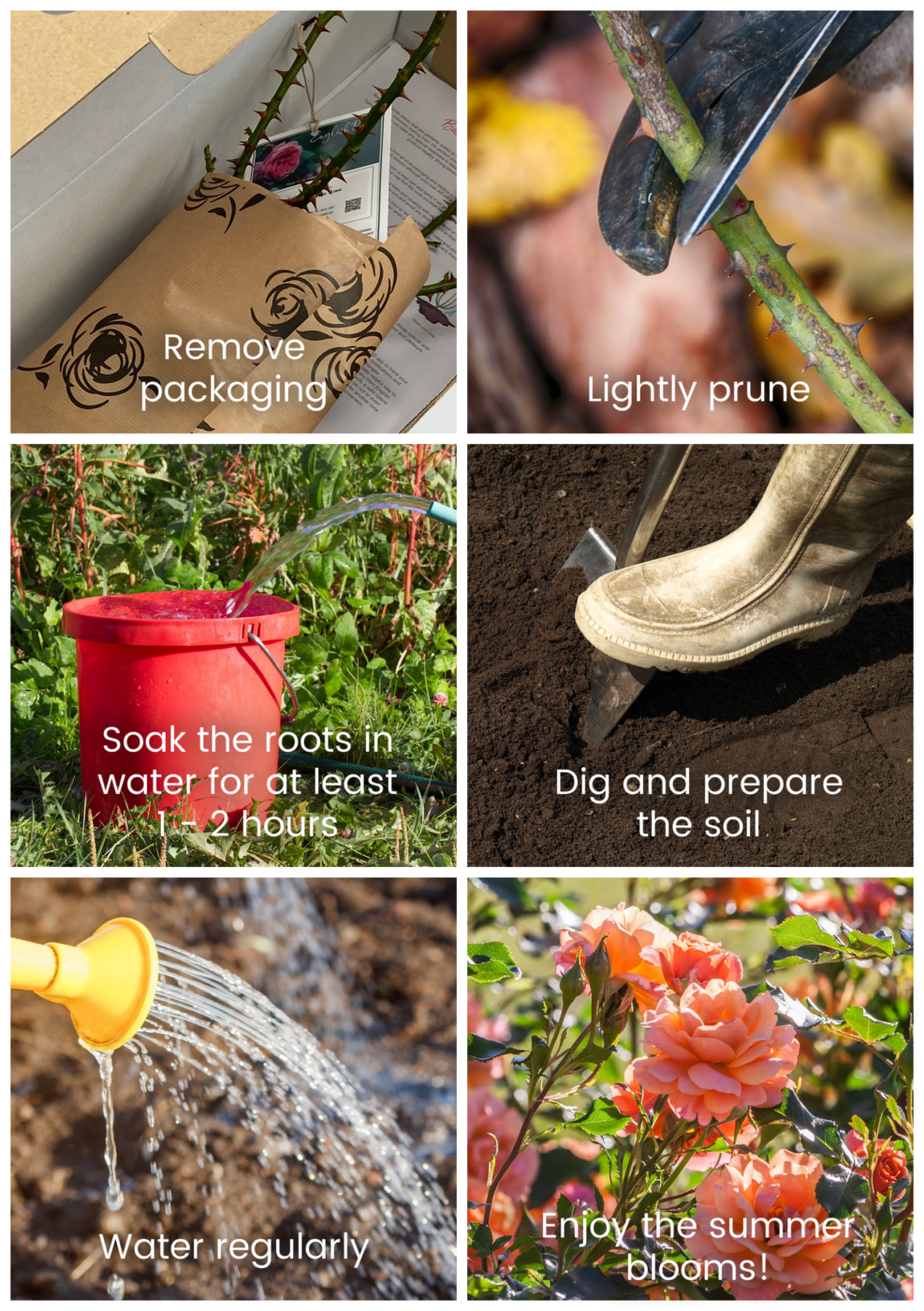
- Remove the bare root rose from all of the packaging. Store the rose in a cool, dark place away from strong wind and frost.
- It is best to plant your rose on the day of delivery, however it will be fine for up to 48 hours if stored in a cool, dark place. If you are not ready to plant your bare root rose, you can store it for up to 2 weeks. It is vital that it is stored in a dark and cool place, such as a shed or garage, away from wind and frost and kept moist at all times. You can achieve this by wetting the roots and covering them with wet compost or newspaper.
- Lightly prune the stems and roots to help promote new growth.
- Soak the roots in a bucket of water for at least 1 – 2 hours before planting.
- Dig a hole and prepare the soil. This needs to be big enough for the roots, approx 16″ (40cm) wide by 16″ (40cm) deep. Break up the soil at the base of the hole with a fork.
- Sprinkle mycorrhizal fungi evenly onto the base of the planting hole.
- Place the bare root rose in the centre with the base of the stems about 5cm below the soil.
- Fill in the hole with a good quality loam based compost and lightly press the soil around the plant.
- Water regularly. Water your rose well and then keep doing this regularly so it doesn’t dry out.
- Continue watering and wait until spring when you can expect to see new growth and foliage. Then, when the warm summer months come around, you will be able to enjoy all the beautiful blooms your rose produces!
How to re-pot your rose #
Rose bushes can also be grown in pots which can be useful if you don’t have garden space or would like to add some colour to a patio. The planting process is very similar to planting a rose in the ground, just make sure that you increase the container size as it begins to outgrow it. For climbing or rambler roses, you will need to ensure that it is placed in a suitable location with plenty of space for it to climb. You will also need to use a large container. If you are looking for a smaller sized rose, a Patio variety would be a great selection due to its small size. We also offer a Willow basket planting service, where our rose care team will specially plant your rose into a 14L willow basket. This container is large enough for the rose to stay in for a couple of years and makes the perfect gift!

To plant your rose in a container, follow these steps:
- Make sure the container is large enough for the plant to grow into and is not overcrowded. Make sure it also has good drainage by having drainage holes. You can also add broken pots or polystyrene blocks at the bottom of the container to help with drainage.
- Prepare the soil. Mix some peat free rose compost and a sprinkle of granular rose feed. Pour some of the soil into the bottom of the container. Leave a hole for where the rose plant will sit.
- Remove the rose carefully from its container. This is usually done by gripping the rose firmly (using gloves!) and inverting the container. Keep the soil that comes in the container.
- Gently loosen the roots slightly so they will spread out well when planted.
- Position the rose in the centre of the container. The bottom of the stems should sit about 2″ (5cm) below the top of the hole.
- Fill the container all around the roots, using the soil you prepared (plus the soil removed from the container).
- Firm the soil lightly.
- Water the rose well, and apply mulch around the base.
- Continue to care for your rose at it becomes established, watering well and using granular rose feed (applied according to product instructions).
- When the rose looks like it is outgrowing the container, you can replant it into a larger pot.
How to plant a bare root rose in a container #
The process of planting a bare root rose into a container is very similar to the above steps.
Here is some additional advice to follow:
- Make sure you plant the bare root rose during the bare root season. November time is usually a good time as it is less likely to have frosty conditions or severe weather.
- Before placing the roots into the pot, sprinkle some mycorrhizal fungi over the roots and onto the base of the planting hole.
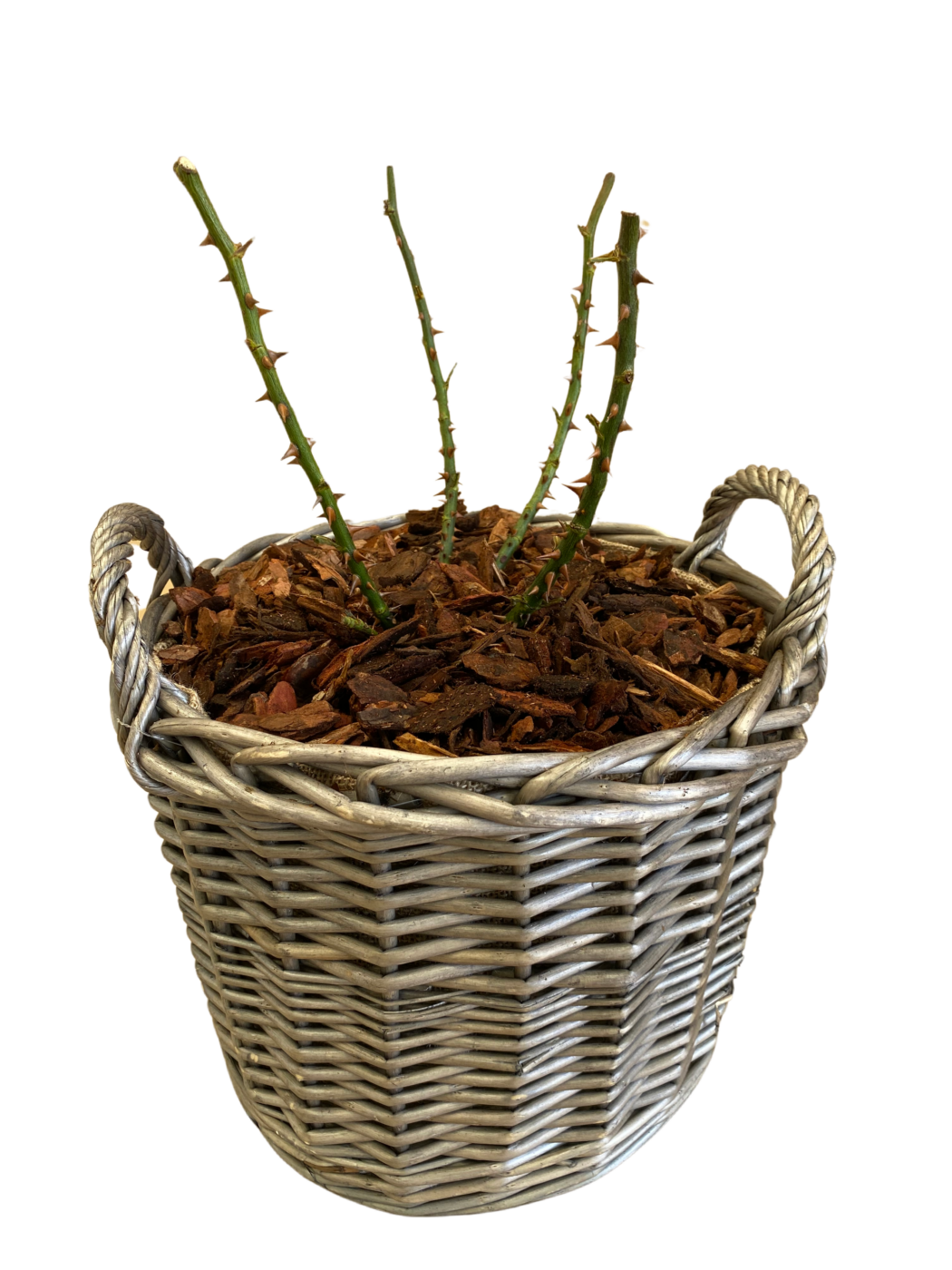
You will now have a rose that is ready to establish a good root system, which will ensure it can thrive in your garden!
Pot Sizes #
Our standard containers are made from recyclable plastic and have a volume of approx 5.5L. Roses will be happy in these for a month or so before needing to be repotted or planted – these are not intended to be used as permanent containers.
Our large willow basket is exclusive to English Roses and has an approximate volume of 14L. Roses bought with this upgrade will be potted by our expert team prior to dispatch, making a wonderful patio ready gift! Compact patio varieties will be happy in the willow basket for up to 5 years, while the slightly larger floribunda and hybrid tea roses may need repotting after 2 years.
Please keep potted roses well watered, as they cannot access water from the surrounding soil like planted roses can! Daily watering in the summer months is essential, and even in wet weather do not rely on rainwater. Please see our watering guide for more information.
How To Choose A Rose Pot #
When choosing a pot for your rose it is important to factor the size – basically bigger is better! The larger the volume of the pot, the more your rose’s roots can grow. We’d recommend a minimum volume of 14L, and a minimum diameter of 30cm. (Climbing roses will need even larger pots due to their large growth habit and extensive root system. If the container is too small they may become stunted.)
Your pot will also need to be free draining, as roses do not like sitting in stagnant water.
Is My Rose Root Bound? #
Roses can become root bound if the pot is not large enough, for example if left in the 5.5L container for a year. The roots run out of space to grow, and eventually start to die back. Once the roots are affected they can no longer get the nutrients needed to grow the rose effectively and keep it healthy, and so the rose itself will start to suffer. The soil in the pot is also less able to retain water, and thus the rose can dry out incredibly quickly even with regular watering.
Luckily roses are hardy plants, and should be able to bounce back from this if treated in time. Simply repot your rose into an appropriate container, or plant into the garden, as soon as possible. Use a high quality rose-suitable compost, and water regularly.
For more information on general Rose Care, including feeding and watering, please click here.